PSA grades tens of millions of cards annually. And among those, there are millions of cards that are worth LESS than the cost to grade them! The #1 question I am asked on a regular basis is, “Should I get my cards PSA graded?”
After reading this blog, you should gain greater clarity on whether your card(s) should be PSA graded. Don’t forget, there is a financial commitment, so it’s imperative you understand the risk/reward scenario.
What Is PSA Grading?
Since 1991, PSA has been grading cards and authenticating autographs. Today, PSA grading plays an important role in the sports collectibles hobby because it:
- Provides an independent assessment of a card’s authenticity and condition.
- Gives buyers and sellers a common standard for evaluating and pricing cards.
- Is the industry’s leading grading service, with PSA-graded cards consistently bringing the strongest prices.
To understand why third-party grading matters, it’s helpful to compare it to buying and selling raw (ungraded) cards. When you walk around a card show or browse the inventory at a local card shop, you’ll see numerous raw cards. The dealer at the show or the proprietor of the local card shop is incentivized to inflate the condition of a raw card because higher-grade cards sell for more. This creates an inherent conflict of interest.
Third-party grading puts the buyer and seller on more equal footing. Instead of relying solely on the seller’s opinion, both parties can rely on an independent assessment of the card’s authenticity and condition. That creates greater confidence in both the card’s grade and its expected price range.
As with any grading company, PSA has competition. However, PSA-graded cards consistently sell for significantly more than comparable cards graded by most other grading companies.
The PSA Grading Scale: 1 Through 10
Trading cards are graded on a scale of 1-10. 10 is a perfect card, while a 1 will display significant condition issues.
Corners, registration, centering and edge wear are some of the criteria a card grader will review. In addition, the card might exhibit staining from being inside a pack. Tobacco stains, bubble gum stains, and caramel stains are frequently found in specific card issues. The card condition will impact the card value.
Gem Mint (PSA 10) and Mint (PSA 9)
A PSA 10 (Gem Mint) is considered a virtually perfect card. All four corners are razor sharp, the centering is perfect or near perfect, the registration is sharp, and there are no stains or noticeable print defects.
A PSA 9 (Mint) often looks virtually identical to a PSA 10 to the naked eye. The difference might be a minor wax stain, one corner that isn’t perfectly sharp, or centering that’s just slightly off.
Despite those seemingly minor differences, the value can be dramatically different.
Take the 1986 Fleer Michael Jordan rookie card (#57), for example. A PSA 10 sells for approximately $300,000. The exact same card in a PSA 9 sells for approximately $30,000—just 10% of the PSA 10 value.
That’s why professional grading matters. Small flaws that many collectors can’t even see can have an enormous impact on market value.
Most modern cards pulled directly from packs will ultimately receive either a PSA 10 or PSA 9. Handle them carefully, and always use proper storage materials, such as a Card Saver, to avoid damaging the corners before submitting them for grading.
Near Mint–Mint (PSA 8) Through Excellent (PSA 5)
A PSA 8 (Near Mint) card is one that is still high-end. However, a few imperfections can start to become accentuated. Rounded corners, staining, registration issues, or centering prevent this card from grading higher.
Vintage cards (pre 1975) that are graded a PSA 8 or even higher sell for large amounts of money.
There are a few reasons for this:
- True scarcity: These cards are hard to find and even harder to find in Near-Mint or better condition.
- Supply & demand: Limited supply, and most were thrown away decades ago during a move or when the children went off to college
- Player greatness: Some of the greatest athletes to ever play a sport are vintage players, making the cards themselves rare by nature (Babe Ruth, Lou Gehrig, Walter Payton, Bronko Nagurski, Wilt Chamberlain, Joe Namath, etc).
Lower Grades (PSA 4 and Below)
Most vintage cards will fall into this category, as most have been handled and played with over many decades. These are “collector” grade cards. These cards will exhibit noticeable creasing, well-rounded corners, staining, off-center, and sometimes poor registration. There was little to no quality control at the printing press pre-1960. If a card were cut off-center or with poor registration, it would still get inserted into packs for nationwide distribution.
A low-grade card does NOT mean it’s worthless. The “holy grail” of baseball cards is the T206 Honus Wagner. A PSA 1 will sell for millions of dollars. There are numerous other examples in which a low-grade card will sell for considerable sums.
Everybody thinks their cards are perfectly mint and will grade a 9 or 10. This may happen if it’s a modern card pulled from a pack. For vintage, it’s almost impossible for the card to grade high.
Half Grades
PSA offers half-point (.5) grades for cards that visually appear better than the technical grade. The highest .5 grade is an 8.5 (PSA 9.5’s do not exist). The grader may feel that your card is technically a 4.0. However, it presents better than the 4.0. Therefore, the grader will bump the card up to a 4.5
What Do PSA Graders Actually Look For?
Every PSA grade is based on the card’s overall condition. PSA graders evaluate four key areas: centering, corners, edges, and surface condition. A flaw in any one of these categories can lower the final grade, which is why two cards that look nearly identical can end up with very different grades and values.
Centering
People tell me all the time that their cards must be a PSA 10 or PSA 9 because the corners are perfect. Whether I also agree to the card’s condition is a moot point. If your card isn’t centered 55/45 on the front and 75/25 on the reverse, it will NOT grade as a PSA 10. PSA 9 centering must be 60/40 or better on the front and 90/10 or better on the reverse.
Many believe that PSA grading is subjective. That may be the case with lower-graded cards. With higher grades, there is NO subjectivity. Technical specifications matter. Centering issues are the #1 reason why a card will not grade as a PSA 10 (assuming corners are razor sharp).
If a card is severely off-centered for its grade, PSA will slab it with an O/C qualifier (Off Center).
For example: 1951 Bowman #305 Willie Mays PSA 6 O/C. The value of a PSA graded off-centered card is substantially less than that of a non-qualifier card. O/C qualifiers knock the value down at least 2 full grades. In this example, the 1951 #305 Willie Mays card is valued at PSA 4.
Corners
Corners are the #1 reason why a card is graded high or low. Any rounding, fraying, or dings on the corners are detrimental to the value of a card. You may have a card with 3 razor-sharp corners. However, the fourth corner has a slight ding. All cards are graded by reviewing all 4 corners.
You need to have all 4 corners razor-sharp for it to qualify for a high grade.
Cards are reviewed under high-power magnification. There might be some noticeable wear that is only detectable under magnification. It’s imperative that you also review the corners on the reverse. PSA graders look at the corners on both the front and the reverse. Just because a card was pulled from a pack, it doesn’t always mean each corner is razor sharp.
Corners can get dinged or bent in shipping or during the opening of a pack. I have also seen cards get dented when the owner tries to insert a card into a card saver sleeve. (Always seek professional guidance if unsure how to do this.)
Edges
For the novice, the edges of a trading card are easily skipped over. “Bad” edges may not seem obvious to the naked eye.
You have to tilt and turn the card over. Look at the edges in different forms of light. Do you see any chipping?
The condition will be more obvious after you thoroughly inspect the card.
Again, make sure to turn the reverse over to see the edges. The front surface of a card might be white. However, the reverse is black. It’s much easier to detect chipping or roughness on the reverse.
Look out for discoloration on the borders.
There are some cards, such as the 1986 Fleer #57 Michael Jordan rookie, whose edges people color to make the card more presentable.
With vintage cards, it’s much easier to detect edge wear. Modern cards don’t have much, if any, edge wear as they are usually inserted into protective sleeves.
Surface
Last but not least, surfaces play a vital role from a professional grading perspective. Many surface issues come straight from the trading card manufacturer. Dots, bubbles, print lines and other defects can happen before you even touch the trading card. You may have a “mint” card (edges, corners, centering), but a card won’t be a MINT 9 if it has a print defect.
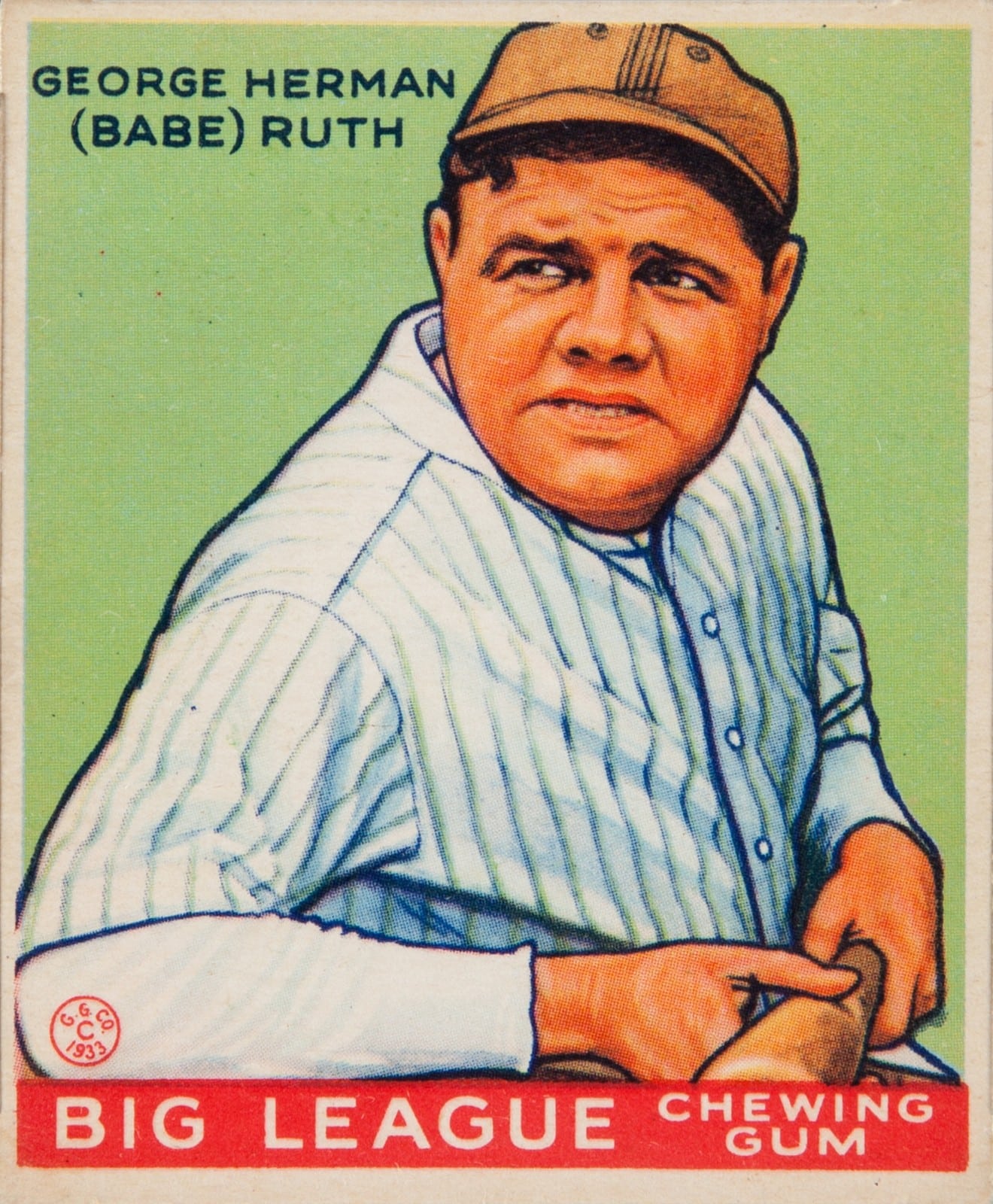
Decades ago, cards were inserted into packages of cigarettes/tobacco/cracker jacks. Therefore, many of these cards will have staining on either the front or back. Baseball Cards and Bubble Gum became paired together in 1933. Goudey Gum Company in Boston, Massachusetts, created the idea to insert one stick of bubble gum inside each pack of baseball cards. This idea was carried forward into the 1950s and 1960s.
PSA vs. Other Grading Companies
Several third-party grading companies serve the sports collectibles hobby, but they aren’t viewed equally by collectors or the marketplace. In this section, I’ll compare PSA, Beckett (BGS), SGC, and CGC Cards, explain where each company excels, and discuss why the grading company you choose can have a significant impact on your card’s resale value.
Third-Party Grading (TPG) has an immense impact on resale value. Of course, there is the upfront cost, but it’s well worth IF you know what cards make sense to have graded.
SGC has a loyal vintage card following. Tobacco cards and cards from the 1800s collectors seem to gravitate to SGC holders. The “Tuxedo” look (black insert and label) is much appreciated. There are not many modern cards that have been slabbed by SGC. SGC doesn’t grade as many cards on a monthly basis as some other companies, but it has been around since 1998 and has a loyal following.
Beckett (BGS) is a name most people are familiar with, even if they don’t collect. Many remember Beckett from the 1980s and 1990s when the monthly Beckett price guide would be mailed to each subscriber. You would open up the magazine to see if your cards went up or down from the prior month. There were excellent interviews with hobby influencers. Many ultra-modern, high-grade autographed cards are encapsulated by Beckett. Some of the most valuable cards that have ever been sold (Michael Jordan, Kobe Bryant) have been graded by Beckett.
PSA is the world’s biggest third-party grader of sports collectibles. They have been around since 1991. They grade tens of millions of cards per year. PSA grades vintage, modern, and everything in between. They are the hobby leaders. The cost you pay to get each card graded is more than that of the competitors. However, you will definitely get outsized returns when you sell the item. Some people who aren’t interested in selling still want their cards graded by PSA because it will preserve the condition. Once the card has been graded/slabbed by PSA, the condition is solidified.
Which Cards Are Worth Grading?
Not every trading card is worth submitting for professional grading. Before you spend the time and money, consider these four factors:
- Value threshold: If you have a rookie card (first-year card) of a Hall of Fame player, there’s a strong chance it makes sense to have it graded. I usually tell my clients that cards worth $500 or more are candidates for grading, with $1,000 or more being the ideal threshold.
- Condition self-assessment: It doesn’t matter how long you’ve owned the card or how you obtained it—you need to be objective, not subjective. Remove all bias and thoroughly review the edges, corners, centering, and surface. With vintage cards, I guarantee you’ll find several issues, and that’s okay. Just be honest in your assessment.
- Card type: Please make sure the card is original and not a reprint. There are a zillion T206 Honus Wagner reprints on the market. If not authentic, you can throw the card away or donate it. They are not worth getting a professional grade on.
- Non-sports cards: Trading card grading isn’t limited to sports. Pokémon and Magic: The Gathering cards are incredibly popular, and PSA now grades more non-sports cards each month than sports cards. These games have passionate collector communities, and certain cards—such as Charizard—can be extremely valuable in high grades.
How to Prepare and Submit Cards to PSA
Submitting cards to PSA is straightforward. Following the proper submission guidelines can help prevent delays and ensure your cards arrive safely. Here are the two most important steps to get right:
Preparing your cards
Organize your cards by year and card number before submitting them. This makes the process easier for both you and the PSA intake specialist. Each card should be placed in its own Card Saver. Do not submit cards in hard plastic cases or screw-down Lucite holders, as PSA will not grade cards that do not follow its submission guidelines.
Choosing a service level
Selecting the right service level can be confusing for first-time submitters because each tier is based on the card’s declared value, essentially the insurance value you assign when sending the card to PSA.
I know this can seem backward since you’re submitting the card to determine its value. Choose the service level that best reflects your honest estimate of the card’s worth. We all like to think our cards are worth $100,000, but that’s almost never the case.
Don’t focus too much on the estimated turnaround times. Instead, focus on accurately assessing the card’s condition and selecting the appropriate service level.
Understanding Your Results
It may not be obvious what the values are of the cards you just received back in the mail from third-party grading. PSA does not email you the values with each corresponding grade. You will have to find the information on your own or hire a professional sports appraiser.
Insider Tips from a PSA Lead Appraiser
As the Lead Appraiser at PSA, I’ve evaluated countless trading cards and helped collectors navigate the grading process. Here are a few practical tips I’ve learned over the years that can help you avoid common mistakes, set realistic expectations, and get the most out of your PSA submission.
- Be conservative with your declared value. PSA will not reimburse your grading fee if you overvalue a card and submit it at a more expensive service level than necessary. In many cases, it makes sense to submit one or two service levels lower.
- Don’t worry about an upcharge. If PSA contacts you because your card graded higher than expected and is now worth more than your declared value, that’s actually great news. For example, you might submit a card at the $1,500 declared value tier, only to learn it graded a PSA 8 and is now worth more than $10,000. You’ll pay a small upcharge before the card is returned, but that’s a good problem to have.
- Drop off your cards in person whenever possible. If you have the opportunity to attend a PSA event or card show, delivering your cards in person reduces the risk of loss, theft, or shipping delays. If that’s not practical, PSA Authorized Dealers can also submit cards on your behalf.
- Set realistic grading expectations. Assume your cards won’t grade quite as high as you hope. High-grade cards command premium prices because there are often only a handful in that condition worldwide. If your card comes back lower than expected, don’t be discouraged. The grading process is complete, and you can now decide whether to keep or sell it.
- Be patient. PSA processes an enormous volume of submissions, and turnaround times can sometimes be longer than expected. If your cards are delayed, don’t panic. Give the process a little more time before contacting PSA.
Ready to Understand What Your Collection Is Worth?
Professional grading is an important part of understanding a card’s condition, but it’s only one factor in determining its value. A professional appraisal is an independent assessment of your collection that evaluates authenticity, condition, rarity, provenance, and current market demand to establish its fair market value.
As the Lead Appraiser at PSA with more than 30 years in the hobby, I provide objective, USPAP-compliant appraisals that collectors, families, attorneys, and financial professionals can trust.